
Philosopher Broz; Tech Kings
Is it where we say Plato was wrong, or do we redefine the King?

Plato’s philosopher does not want to return to the cave. He has seen the sun, and the prospect of descending back into shadows, back among people who will mock his adjusted eyes and his strange new claims about the nature of light, is genuinely repellent to him.
He goes back anyway.
The reluctance, for Plato, is not a personality trait, perhaps a philosophical credential.
Elon Musk did not wait to be compelled.
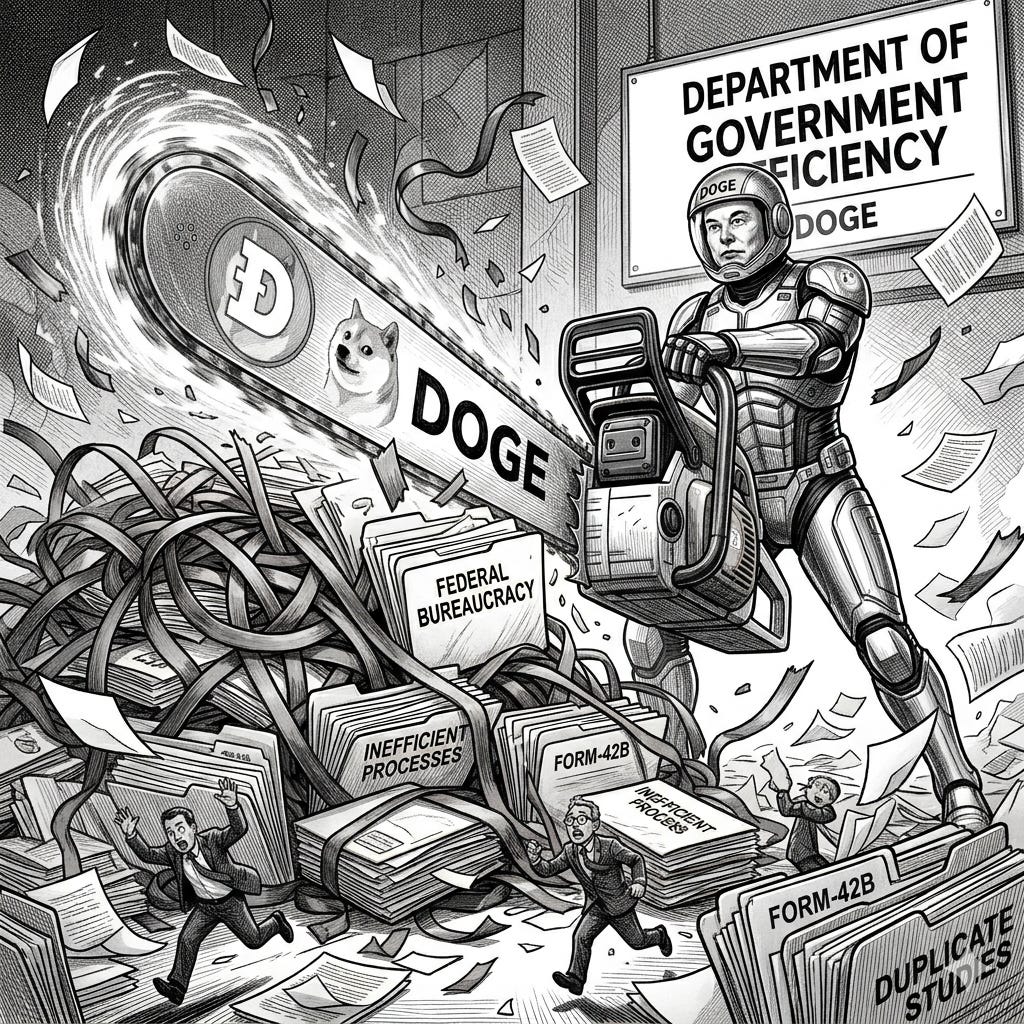
He pitched the idea of DOGE to Donald Trump while Trump was still a candidate. He named it himself, staffed it with his engineers, and arrived in Washington with a chainsaw in hand, literally, at CPAC, before anyone had formally agreed he should.
On paper, DOGE had little institutional authority. In practice, it charged ahead with the most drastic reshaping of the federal bureaucracy in recent memory.¹ A federal judge found him to be DOGE’s de facto leader; the White House simultaneously denied he was making decisions and insisted Musk was in charge.
A coalition of states filed suit arguing that “the sweeping authority now vested in a single unelected and unconfirmed individual is antithetical to the nation’s entire constitutional structure.”²
Consider a thought experiment: in a parallel universe, Elon Musk is not only a visionary technologist but also a genuinely compassionate one, someone who acquires enormous power and wields it for the people rather than over them. He builds, governs, and serves with wisdom and good intent.
Would we call him a Philosopher King?

If the answer is yes, then the Philosopher King is fundamentally a question of character, not capability. If the answer is no, then what’s missing? Intent?
So the question isn’t whether our hypothetical Musk is smart enough or powerful enough. It’s whether he is good enough, and whether “good enough” is even separable from the kind of person who would never accumulate that power in the first place.
This is not, at its core, a story about Elon Musk. He is the most visible instance of a structural problem. Consider Palantir. Founded by Peter Thiel in 2003, it has spent two decades doing something quieter and more consequential than any press conference: becoming the epistemic infrastructure of the American state. ICE has spent over $200 million on Palantir contracts, using the software to integrate travel histories, visa records, biometric data, and social media data. The DOW has awarded Palantir billion-dollar contracts for battlefield intelligence and AI-driven analysis. Domestic agencies, including the CDC, the IRS, and local police departments, have contracted with Palantir for data integration.³
By 2025, the company had repositioned itself as a systems-level AI infrastructure provider embedded across mission domains, consolidating wide adoption across the federal government.⁴
What this means, in plain terms, is that the categories through which the American government sees, the data architectures that determine who gets flagged, who gets paid, who gets watched, are increasingly built and maintained by a private company whose founders have specific ideological commitments and specific financial interests. Former Palantir employees warned that the platform “grants immense power to its users, helping control the data, decisions, and outcomes that determine the future of governments, businesses, and institutions — and by extension, all of us.”⁵
The philosopher-king ideal is not just about who governs. It is about what kind of knowledge qualifies a person to govern. Similarly, Platonic episteme is not technical competence, nor is it the ability to optimize a payment system, train an ML model, or build reusable rockets. It is knowledge of the Good: an understanding of what humans require, arrived at through philosophical education and the discipline of desire.
The tech bro does not claim this kind of knowledge (not too sure though). He claims a different kind: the knowledge of how things work, of efficiency and scale, of systems optimization. This is knowledge that, in Plato’s terms, sits closer to what the craftsman has, techne, not episteme.
Musk, calling himself the first friend of efficiency, is no different, philosophically, from the cave-dwellers congratulating each other on their shadow-reading — only the vocabulary changes. The structural delusion does not.
On the contrary, what exactly does liberal democracy offer as an alternative? If the answer is the informed consent of the governed, then the next question is whether that consent can survive an information environment built by the same people seeking to govern.
Musk owns X. Palantir is the Orwellian Big Brother. Andreessen’s venture capital funds the AI companies whose products now mediate public discourse. The crypto industry alone donated at least $26 million to Trump in the first half of 2025.⁷
The epistemic conditions required for democratic self-governance, an informed public capable of meaningful consent, are being eroded by the same concentration of technical power that the philosopher-king critique is supposed to check.

Democracy can replace epistemic authority through the electoral process, through public awareness robust enough to cut through the attention economy, and through institutional accountability that outlasts administrations. But it can only do this if it first defeats the very forces, platform capture, algorithmic attention management, and the lobbying machinery of firms offering themselves as the solution that the current moment has made structural.
What does it actually feel like to live under someone with epistemic authority over your information environment, your government’s data architecture, your policy levers? Probably much like this: we don’t notice it most of the time. The philosopher-king’s most seductive quality, Plato understood, is that good governance is largely invisible. The system reveals itself only when it fails you, when the algorithm flags you, when the payment stops.
We may be finding out soon…
ENDNOTES
¹ Axios, “Elon Musk’s DOGE is overhauling the federal government: Here’s what to know,” February 7, 2025.
² Christian Science Monitor, “DOGE administrator is named, and it’s not Musk. How this ‘department’ works,” February 26, 2025. The quoted language comes from a coalition lawsuit filed against DOGE challenging the constitutional basis of Musk’s authority.
³ The Conversation, “When the government can see everything: How one company, Palantir, is mapping the nation’s data,” January 20, 2026.
⁴ FedSavvy Strategies, “Palantir Federal Growth: AI Expansion, Army Enterprise Agreement, and Implications for Golden Dome for America,” August 25, 2025.
⁵ Tax Notes, “Palantir Contracts Under Scrutiny Amid IRS Tax Data Controversy,” February 20, 2026. Quoting an open letter signed by 13 former Palantir employees.
⁶ Plato, The Republic, Book VII, 520d. Trans. Benjamin Jowett. The full passage: “The State in which the rulers are most reluctant to govern is always the best and most quietly governed, and the State in which they are most eager, the worst.”
⁷ Revolving Door Project, “DOGE: From Meme to Government Erosion Machine,” January 20, 2026.
Shoshana Zuboff, The Age of Surveillance Capitalism (PublicAffairs, 2019)